Exploring Data Relationships with Correlation Graphs
In today’s data-driven world, understanding how different variables relate to one another is essential for making informed decisions. Whether in business, finance, healthcare, or scientific research, identifying patterns and relationships within data can uncover valuable insights that drive strategy and innovation. Among the various tools available for this purpose, correlation graphs stand out as one of the most effective and intuitive methods for visualizing relationships between variables.
At its core, a correlation graph helps users understand whether two variables are related, and if so, how strong that relationship is. For example, a business might want to know whether increased advertising spend leads to higher sales, or a researcher might explore how temperature affects a chemical reaction. By plotting data points on a graph, users can quickly see whether variables move together, move in opposite directions, or show no clear relationship at all.
Traditionally, creating such graphs required a combination of statistical knowledge and technical tools. Users often needed to calculate correlation coefficients manually or rely on complex software to generate visualizations. This process could be time-consuming and, for many, difficult to manage without proper training. As a result, valuable insights were sometimes overlooked simply because the tools were not accessible.
With the development of modern digital tools, this challenge has been largely addressed. A correlation graph generator allows users to transform raw data into meaningful visualizations with minimal effort. Instead of manually calculating and plotting each data point, users can input their dataset and generate a graph within seconds. This not only saves time but also reduces the risk of errors, making the analysis more reliable and efficient.
One of the key advantages of using a correlation graph generator is its ability to simplify complex data. Large datasets that might seem overwhelming in spreadsheet form can be quickly converted into visual representations that are easy to interpret. Patterns that would otherwise be hidden become immediately visible, enabling users to identify trends and relationships more effectively.
Another important benefit is accessibility. Many modern tools are web-based, meaning they can be accessed from any device with an internet connection. This eliminates the need for installing specialized software and allows users to work from virtually anywhere. For remote teams and distributed organizations, this flexibility is particularly valuable, as it enables seamless collaboration and data sharing.
Ease of use is also a defining feature of modern tools. A well-designed correlation graph generator typically includes an intuitive interface that guides users through the process of creating a visualization. Even individuals with little to no experience in data analysis can quickly learn how to generate and interpret correlation graphs. This democratization of data tools allows more people within an organization to engage with data directly, rather than relying solely on specialized analysts.
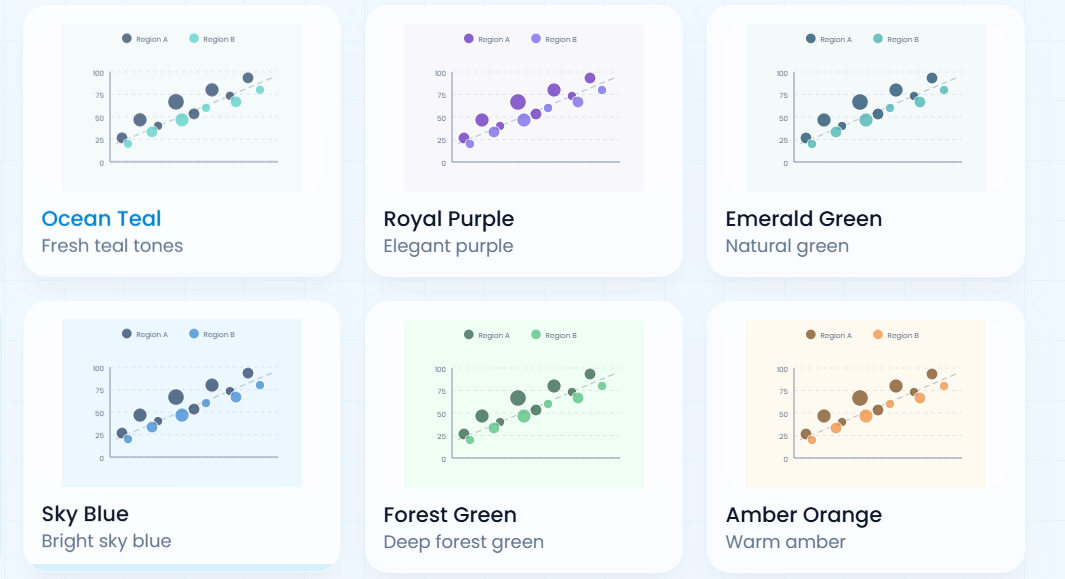
Customization is another critical aspect. Users often need to tailor their visualizations to suit specific purposes, whether for internal analysis or external presentation. Features such as adjustable axis labels, color schemes, point sizes, and the addition of trend lines or regression curves help enhance both the clarity and visual appeal of the graph. A well-customized visualization not only improves understanding but also makes it easier to communicate insights to stakeholders.
From a practical standpoint, correlation graphs are used across a wide range of industries. In finance, they help analysts understand relationships between different assets, such as stocks or commodities, which can inform investment strategies. In marketing, they reveal connections between variables like advertising spend and customer engagement, helping teams optimize their campaigns. In scientific research, correlation graphs are essential for testing hypotheses and validating experimental results.
Another significant advantage is the ability to detect anomalies or outliers. These are data points that deviate significantly from the overall pattern and can indicate errors, unique events, or new opportunities. By identifying these outliers visually, users can investigate further and make more informed decisions.
Scalability is also an important consideration. As data volumes continue to grow, traditional methods of analysis become less practical. Modern tools are designed to handle large datasets efficiently, ensuring that performance remains stable even as the amount of data increases. This makes them suitable for both small-scale projects and large, complex analyses.
Collaboration has become increasingly important in data-driven environments, and many tools support this need by allowing users to share their visualizations بسهولة. Whether through downloadable files or shareable links, teams can quickly distribute insights and work together to interpret results. This collaborative approach enhances productivity and ensures that decisions are based on a shared understanding of the data.
Ultimately, the value of correlation graphs lies in their ability to make complex relationships understandable. They provide a clear visual representation of how variables interact, enabling users to draw meaningful conclusions and take informed actions. By leveraging a reliable correlation graph generator, users can streamline the entire process—from data input to insight generation—making data analysis more efficient and accessible.
In conclusion, as the importance of data continues to grow, tools that simplify analysis and visualization are becoming essential. Correlation graphs play a vital role in helping users understand relationships between variables, and modern tools have made them easier to create and use than ever before. By adopting these tools, individuals and organizations can unlock deeper insights, improve decision-making, and stay competitive in an increasingly data-driven world.